
Advantages of Low-Voltage High-Output Electric Motors
Low-voltage High-Output motors represent a pivotal development branch within the industrial motor sector, delivering robust power output while retaining the operational and deployment merits of low-voltage electrical systems. They have emerged as a preferred drive solution for a wide spectrum of heavy-duty industrial applications, including mining conveyors, water treatment blowers, bulk material handling equipment, and general industrial processing machinery.
One core merit lies in system simplification and reduced capital expenditure. Unlike high-voltage motor configurations that mandate matched high-voltage switchgear, transformers, and dedicated protection cubicles, low-voltage high-power units interface directly with standard low-voltage power distribution networks. This eliminates the procurement, installation and commissioning costs of high-voltage auxiliary equipment, shortens project lead time, and lowers the footprint of electrical rooms, which is highly valuable for plant layouts with constrained space.
In terms of operational safety and maintainability, low-voltageHigh-Output motors feature a lower insulation voltage class and more mature protection schemes. Maintenance technicians can conduct routine inspection, winding resistance testing, fault troubleshooting and component replacement without specialized high-voltage operation permits. The associated low-voltage variable frequency drives (VFDs) for speed regulation are widely standardized, with abundant spare parts resources and intuitive fault diagnosis functions, effectively cutting downtime and lifecycle maintenance costs.
These motors also demonstrate outstanding control flexibility and starting performance. Paired with state-of-the-art LV VFDs, they support soft start, stepless speed modulation, torque closed-loop control and multi-motor synchronous operation. Such capability suppresses inrush current during startup, mitigates mechanical shock to driven loads, and enables energy optimization under variable working conditions. For fans, pumps and other quadratic-torque loads, significant energy savings can be achieved by adjusting operating speed to match actual process demand.
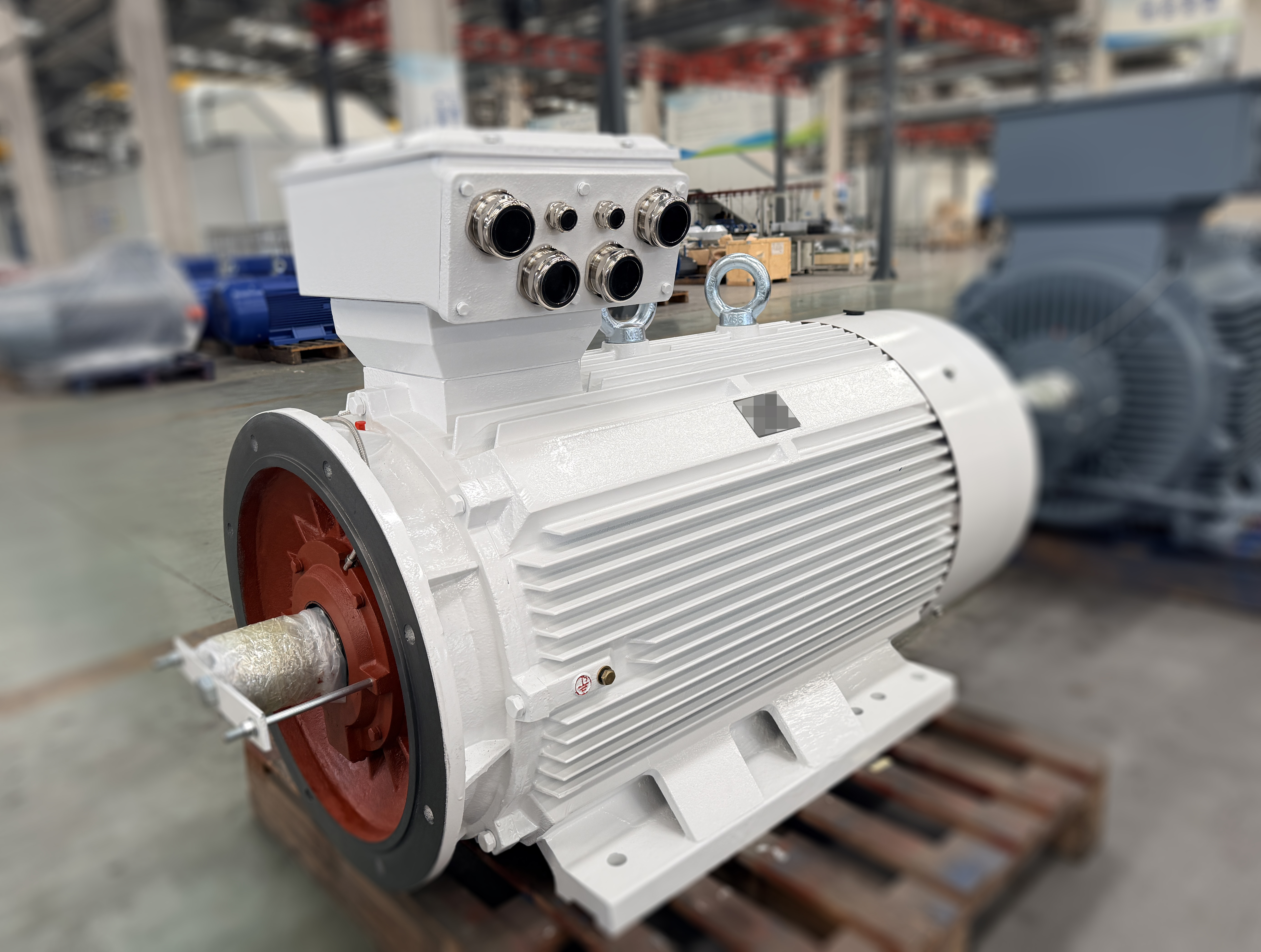
Thermal management and structural reliability are engineered to accommodate high power density. Optimized finned stator frames, high-efficiency cooling circuits and high-grade magnetic materials are adopted to restrain temperature rise under continuous rated load. Premium bearing assemblies, reinforced rotor structures and robust terminal boxes are designed to withstand prolonged heavy-load cycling, vibration and harsh ambient environments. Many models comply with stringent efficiency standards, reaching IE4 or IE5 ultra-high efficiency levels, which curbs active power loss and reduces long-term electricity consumption for end users.
Furthermore, standardization and compatibility strengthen their application value. Low-voltage high-power motors follow universal IEC mounting dimensions and interface specifications, supporting seamless replacement of legacy drives. They are adaptable to diverse protection configurations such as overcurrent, overload, phase loss, bearing temperature and winding temperature monitoring, and can be integrated into plant SCADA and industrial IoT platforms for remote status monitoring, predictive maintenance and intelligent production management.
In summary, low-voltage High-Output motors strike a balanced combination of high power capacity, simple power distribution architecture, convenient maintenance, flexible variable-speed control and high energy efficiency. As industrial processes pursue intelligent, low-carbon and cost-effective drive solutions, this motor category will maintain broad application prospects across heavy process industries.
Post time: Nov-17-2026