
Early Design and Installation Phases
During the early design and installation phases of a motor, several details directly determine the baseline level of shaft current. First is the overall equipotential bonding design: the greatest risk in variable frequency drive systems arises from potential differences between equipment. Reliable equipotential bonding must be achieved among the motor, inverter, control cabinet, frame, and load rack to eliminate circulating currents caused by ground potential shifts.
Second is cable routing: shielded power cables must be used for variable frequency motors, with the shielding properly grounded at both ends to prevent high-frequency radiation from coupling onto the shaft and inducing abnormal voltages. Additionally, the cable length between the inverter and the motor should be optimized as much as possible, since excessively long cables are prone to voltage reflections and high-frequency resonance, which can amplify the amplitude of shaft voltage.
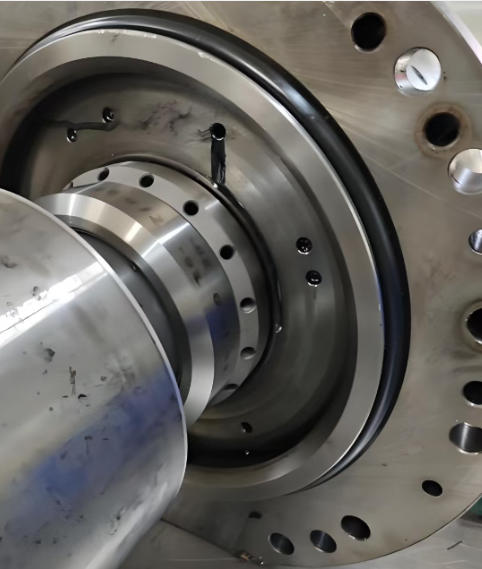
Motor Body Structure & Industrial Case
The design of the motor body structure is also crucial. The stator core is stacked evenly, and the rotor’s dynamic balance accuracy meets the standards. This can effectively suppress the low-frequency shaft current caused by the imbalance of the power frequency magnetic field. The cleanliness of the bearing chamber and the design of the sealing structure can prevent water vapor and dust from entering the bearing chamber, and prevent the lubricating grease from getting damp, deteriorating, and carbonizing. Once the lubricating oil’s insulation performance declines, the breakdown threshold of the oil film decreases. Even a weak shaft voltage can continuously generate micro-arcs, accelerating the electrical erosion of the bearings. Therefore, a good structural design is the foundation for improving the bearing’s anti-electro-erosion ability from the source.
The case of the maintenance and rectification of the fan units in an industrial park’s energy station is highly representative. Multiple 90kW variable-frequency fans in the station have intermittent bearing noises on a regular basis. Although the equipment is equipped with standard SGR grounding rings, the bearing erosion problem still occurs occasionally. After the technicians’ investigation, they found that during the initial operation of the equipment, a unified equipotential grounding was not done, the grounding resistance of the frame was too large, and the aging lubricating grease was not replaced in time during the annual maintenance, resulting in poor stability of the oil film. After re-performing the system equipotential connection, optimizing the grounding method of the shielding cable, and standardizing the regular oil replacement cycle for the bearings, the fluctuation of the shaft voltage of the units significantly decreased, and no bearing erosion faults occurred during the subsequent two years of continuous operation.
Standardized Operation and Maintenance
At the level of daily operation and maintenance, standardized control can significantly reduce the risk of axial current. Firstly, regular axial voltage inspections should be conducted. The industry-standard safety threshold is 300mV. Any deviations must be promptly investigated and rectified. Secondly, strict lubrication management should be implemented to prevent water ingress, dust contamination, deterioration, and drying of the grease, ensuring the integrity and insulation performance of the bearing oil film.
For motors with insulation structures, regular detection of bearing insulation resistance is necessary to prevent insulation failure caused by moisture absorption, dust accumulation, or deterioration of the insulation layer. Additionally, long-term low-frequency operation and frequent startups of the equipment will intensify high-frequency interference. Maintenance personnel should adjust the operation strategies based on the operating conditions to avoid cumulative damage from long-term abnormal conditions.
In summary, the control of axial current cannot rely solely on a single protective accessory. Design optimization and standardized operation and maintenance are indispensable underlying guarantees. Reasonable system grounding, standardized cable layout, reliable motor structure, and regular inspection and maintenance can suppress the generation of axial voltage at the source, enhance the equipment’s anti-interference ability, and extend the service life of the bearings. Design governance eliminates inherent risks, operation and maintenance control prevents subsequent failures, and the combination of the two can achieve long-term and effective elimination of motor axial current problems, ensuring the long-term stable operation of the frequency conversion equipment.
Post time: Oct-08-2026